Yanzhe (Justin) Zhao
Computational Neuroscience | Cognitive Neuroscience | Neuro-AI
B.Eng. in Automation student at the School of Future Technology, Tianjin University. The School of Future Technology is Tianjin University's elite undergraduate college, and its Intelligent Machine Platform honors track admits students through Gaokao-based selection and internal university selection.
After two years of shared training in mathematics, physics, and engineering fundamentals, I selected Automation as my major. I now study how neural and cognitive mechanisms can inform computational models of learning, prediction, and representation.
My academic path started from robotics, control, and reinforcement learning. It is now centered on computational and cognitive neuroscience, with particular interest in world models, predictive processing, neural mechanisms of natural language acquisition, and embodied cognition.
From embodied control to computational models of mind and brain.
Foundation
Robotics and Control Foundation
Built a systems-level base through automatic control, signal processing, robot kinematics, embedded systems, numerical methods, and full-stack robot projects.
Transition
Learning and Decision Making
Used deep reinforcement learning for constrained navigation, connecting policy learning, spatial planning, and action under nonholonomic limits.
Current focus
Computational and Cognitive Neuroscience
Now focusing on neural computation, predictive processing, world models, cognitive maps, language learning, and Neuro-AI models that can be tested scientifically.
Peer-reviewed work on deep reinforcement learning for constrained spatial navigation.
CSAI 2025 | ACM Proceedings | pp. 126-131
Nonholonomic Narrow Dead-End Escape with Deep Reinforcement Learning
Denghan Xiong, Yanzhe Zhao, Yutong Chen, and Zichun Wang. Proceedings of the 2025 9th International Conference on Computer Science and Artificial Intelligence.
Evidence of neuroscience readiness, applied ML, AI implementation, and engineering depth.
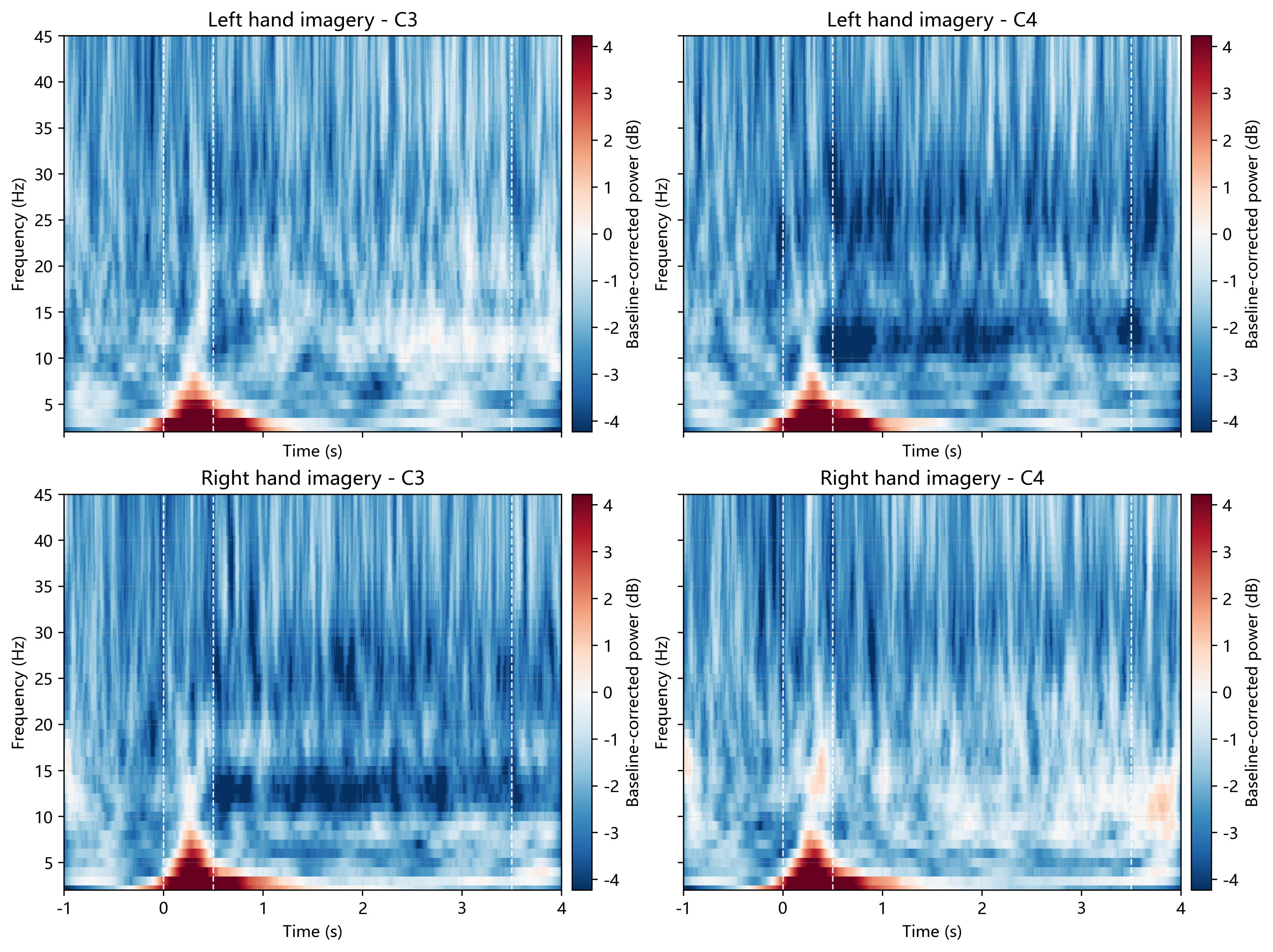
EEG Time-Frequency Analysis with OpenBMI
A reproducible Python workflow for STFT, CWT, wavelet multiresolution, and OpenBMI motor imagery EEG ERD/lateralization analysis.
Role: Built and released the public workflow, regenerated English figures and report, and documented data/privacy constraints.
Methods: Fourier analysis, STFT parameter sweep, CWT, DWT multiresolution, baseline-corrected mu/beta ERD, C3/C4 lateralization
- Compared Fourier spectra, STFT, CWT, and wavelet multiresolution on nonstationary synthetic signals.
- Quantified STFT window-length and window-function tradeoffs in time/frequency resolution.
- Computed baseline-corrected mu/beta ERD and C3/C4 lateralization for OpenBMI motor imagery EEG.
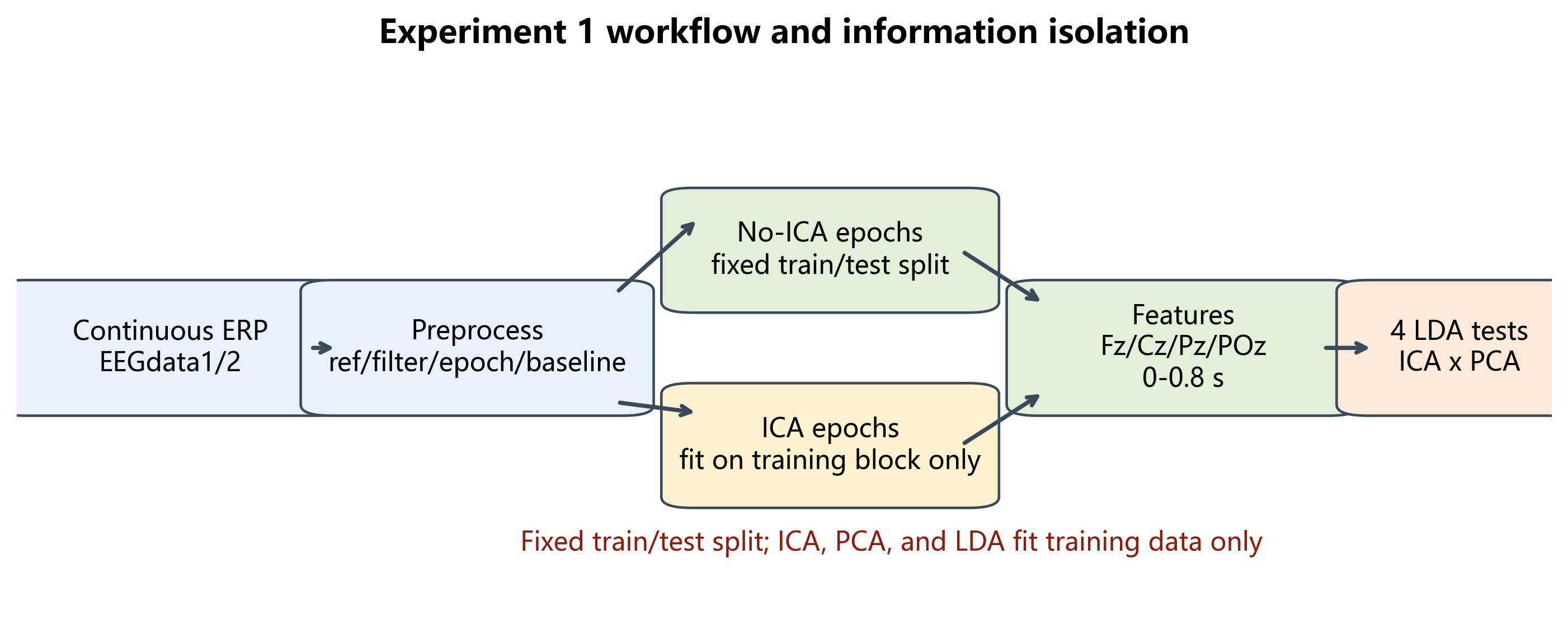
EEG Feature Enhancement and Single-Trial Classification
A reproducible Python implementation of ERP ICA/PCA/LDA target detection and SSVEP TRCA single-trial EEG recognition.
Role: Implemented the public analysis workflow, generated English figures/tables/report, and added regression tests for split logic, PCA/LDA isolation, and TRCA behavior.
Methods: ERP preprocessing, ICA artifact inspection, PCA dimension reduction, LDA classification, SSVEP TRCA, leave-one-block-out validation
- Compared ERP single-trial target detection under ICA/PCA/LDA conditions with strict train/test isolation.
- Evaluated SSVEP TRCA using leave-one-block-out validation and reported the scope of within-subject generalization.
- Included tests for data shape, split logic, PCA/LDA isolation, and TRCA behavior to keep the workflow reproducible.
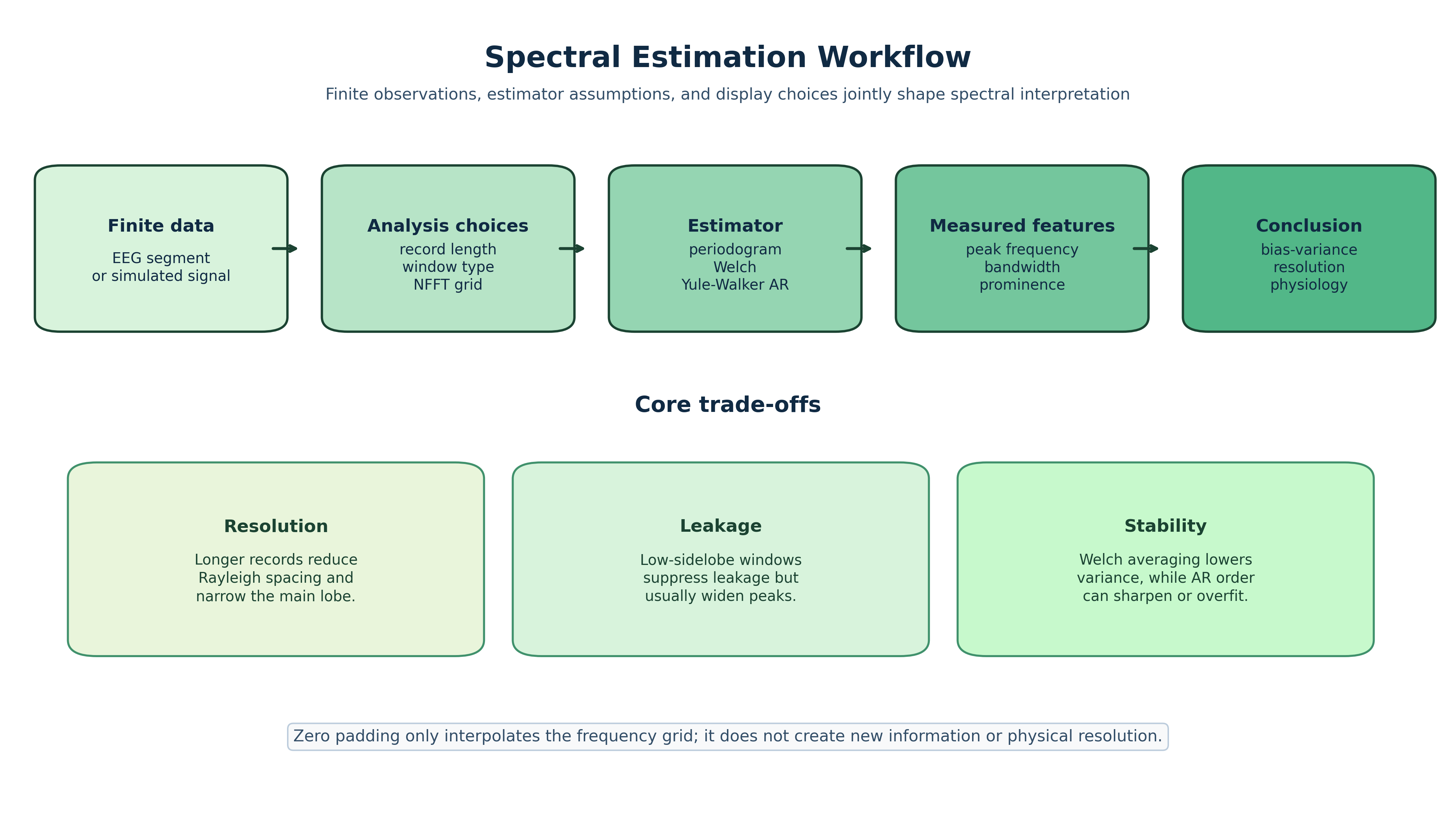
EEG Spectral Estimation
A reproducible study of classical and AR spectral estimators on synthetic signals and LEMON closed-eye resting-state EEG.
Role: Designed the experiments, implemented the analysis pipeline, produced report figures, and wrote the technical report.
Methods: FFT, Hamming periodogram, autocorrelation PSD, Welch PSD, Yule-Walker AR spectra, FPE order selection
- Compared estimator bias, variance, leakage, resolution, and pseudo-peak behavior.
- Connected signal-processing choices to interpretable EEG alpha-band analysis.
- Maintained absolute one-sided PSD reporting in dB/Hz for reproducible comparison.
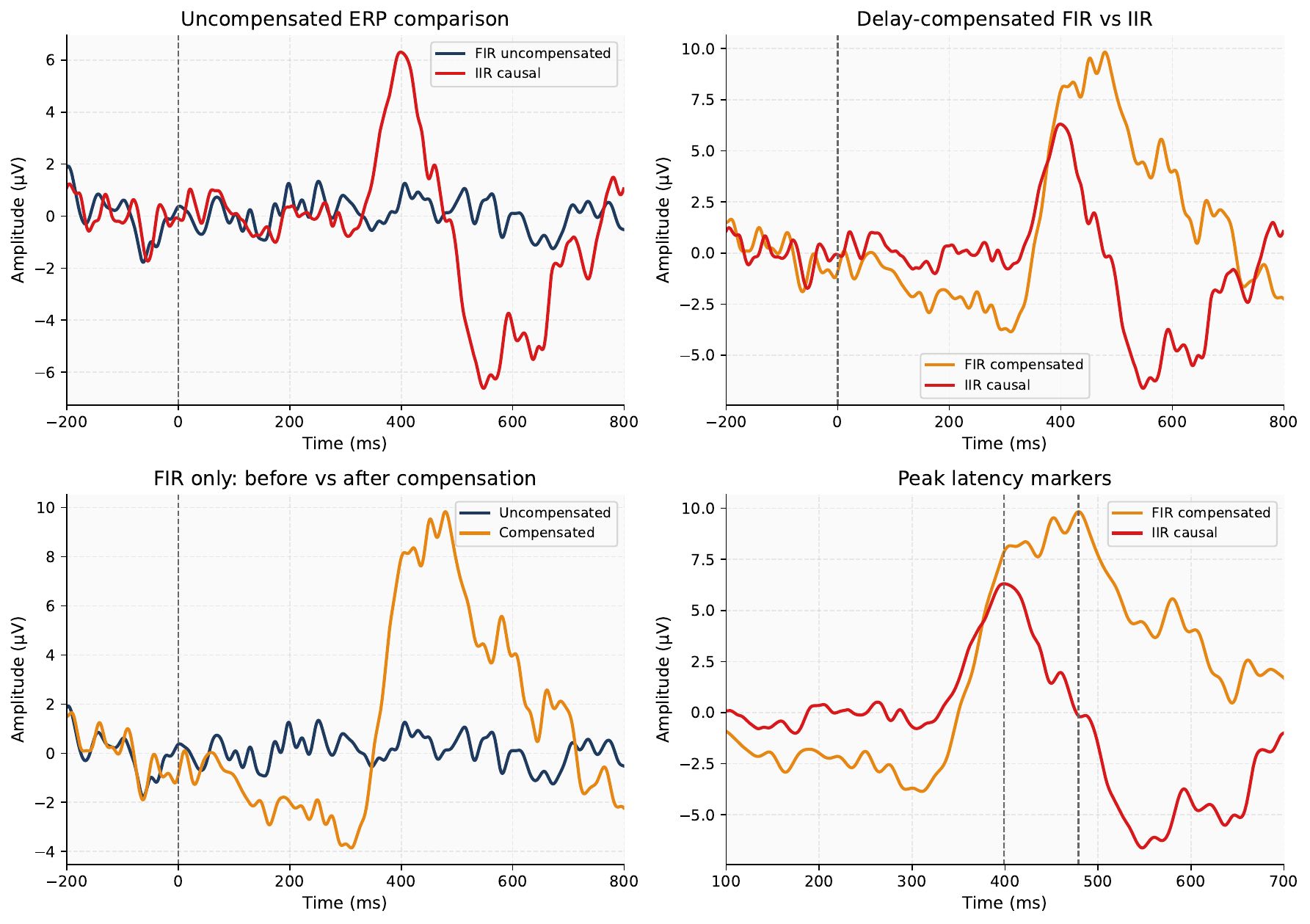
ERP Filtering and EEG Preprocessing
A complete ERP filtering study covering IIR/FIR filter design, EEG preprocessing, waveform interpretation, and bilingual reporting.
Role: Implemented filter comparisons, ERP analysis, quantitative summaries, and publication-style reports.
Methods: IIR/FIR filter design, zero-phase filtering, delay analysis, baseline drift suppression, ERP waveform comparison
- Compared Butterworth, Chebyshev-I/II, and elliptic IIR filters under matched specifications.
- Measured latency distortion from causal filtering and corrected interpretation with zero-phase filtering.
- Used real ERP data to connect filter design to cognitive-neuroscience waveform analysis.
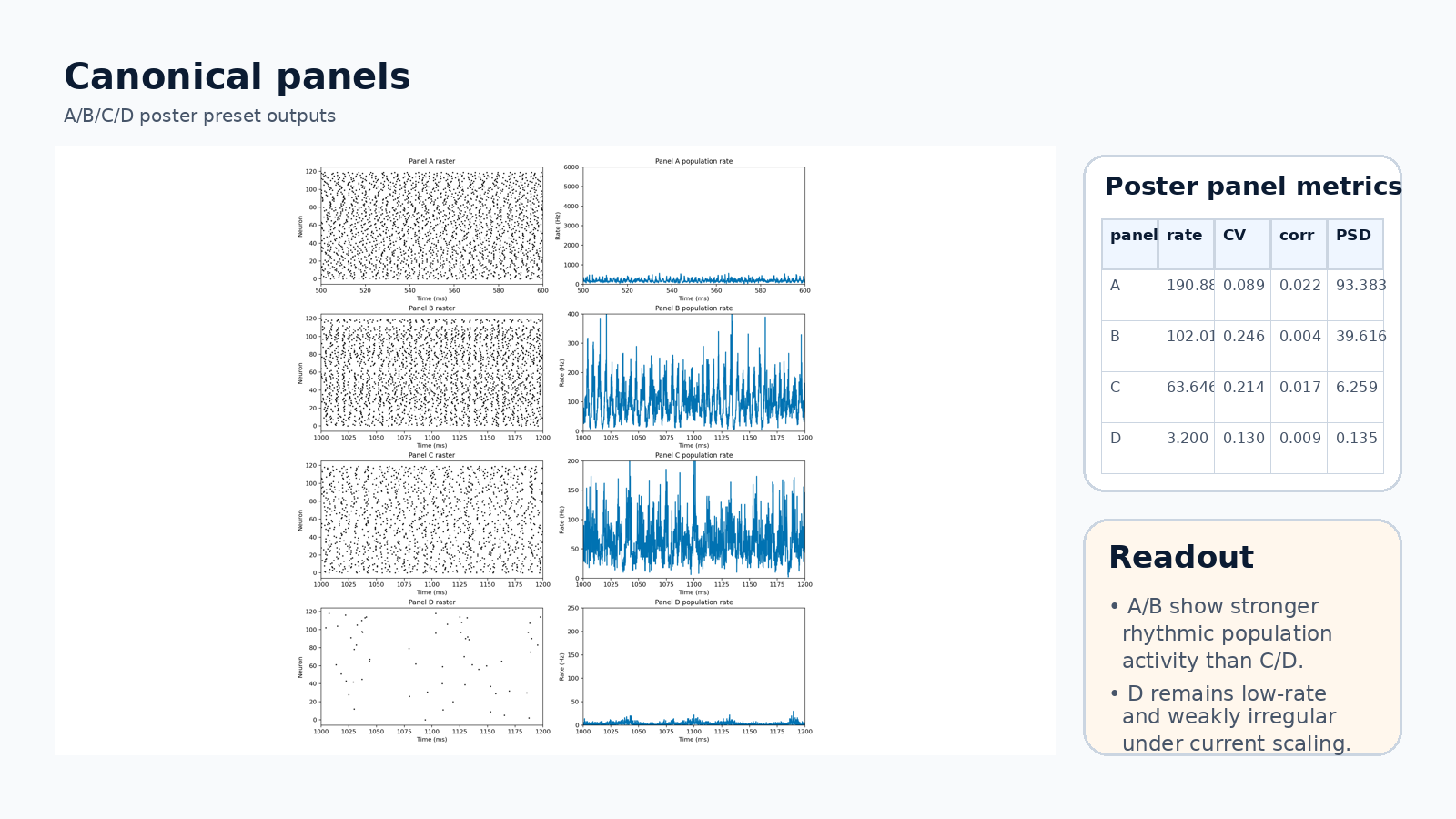
Brunel Balance Network
A Brian2 reproduction and analysis of canonical sparse excitatory/inhibitory spiking network regimes from Brunel 2000.
Role: Built the simulation workflow, generated canonical panels and sweeps, documented limitations, and packaged deliverables.
Methods: Leaky integrate-and-fire networks, E/I balance, parameter sweeps, population-rate analysis, acceptance checks
- Reproduced multiple canonical population activity regimes with explicit configuration control.
- Generated raster, population-rate, phase-diagram, and metric figures for presentation.
- Recorded model-scaling and validation tradeoffs instead of hiding imperfect cases.
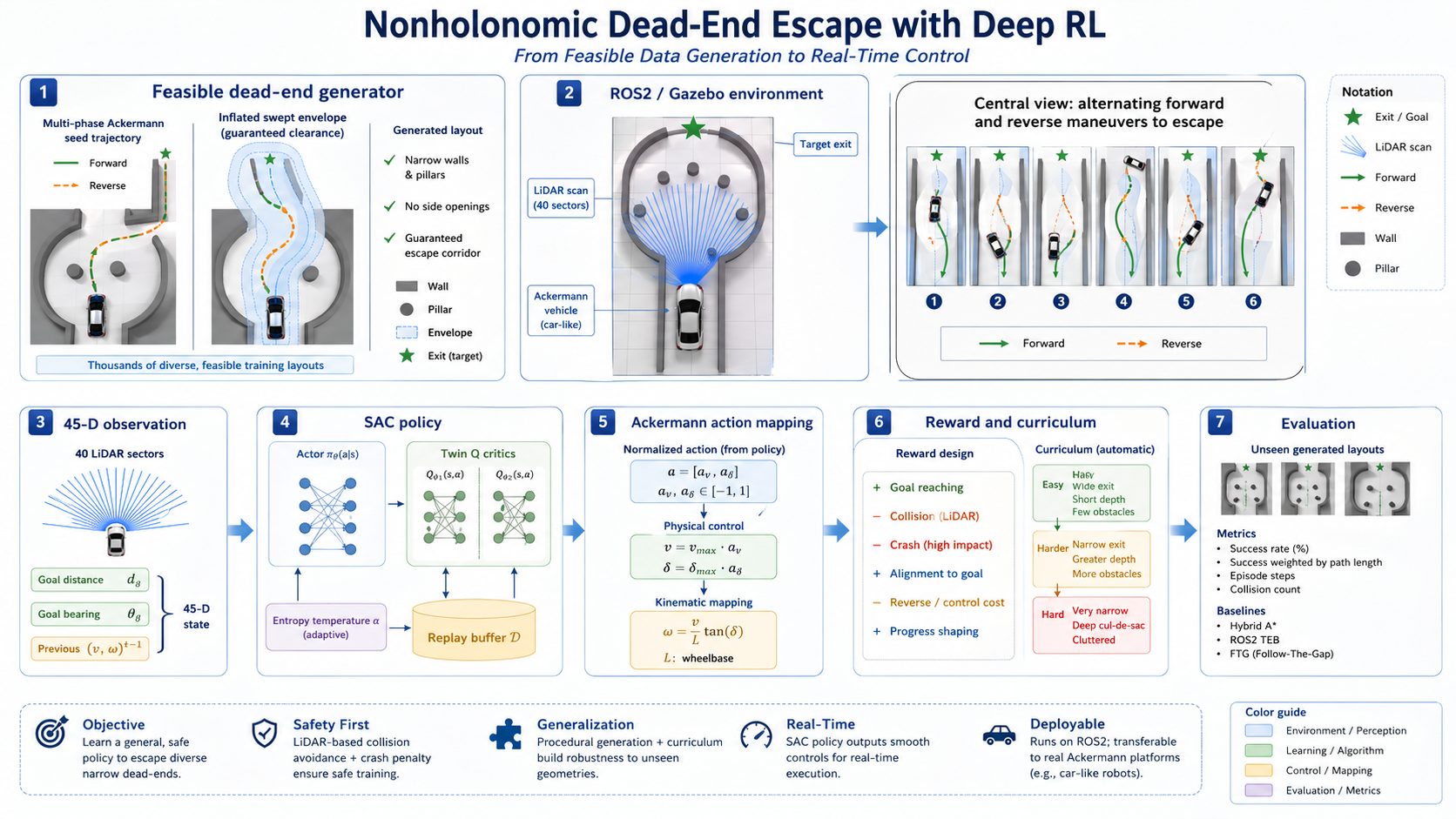
Nonholonomic Dead-End Escape with Deep RL
A SAC-based navigation and evaluation stack for Ackermann-style robots escaping narrow dead-end environments.
Role: Contributed to problem formulation, training/evaluation workflow, environment generation, and experimental engineering.
Methods: Soft Actor-Critic, ROS2/Gazebo simulation, nonholonomic constraints, procedural dead-end generation
- Connected reinforcement learning with spatial planning under tight nonholonomic constraints.
- Benchmarked learned policies against representative classical planners.
- Became the formal CSAI 2025 conference paper now indexed with ACM DOI.
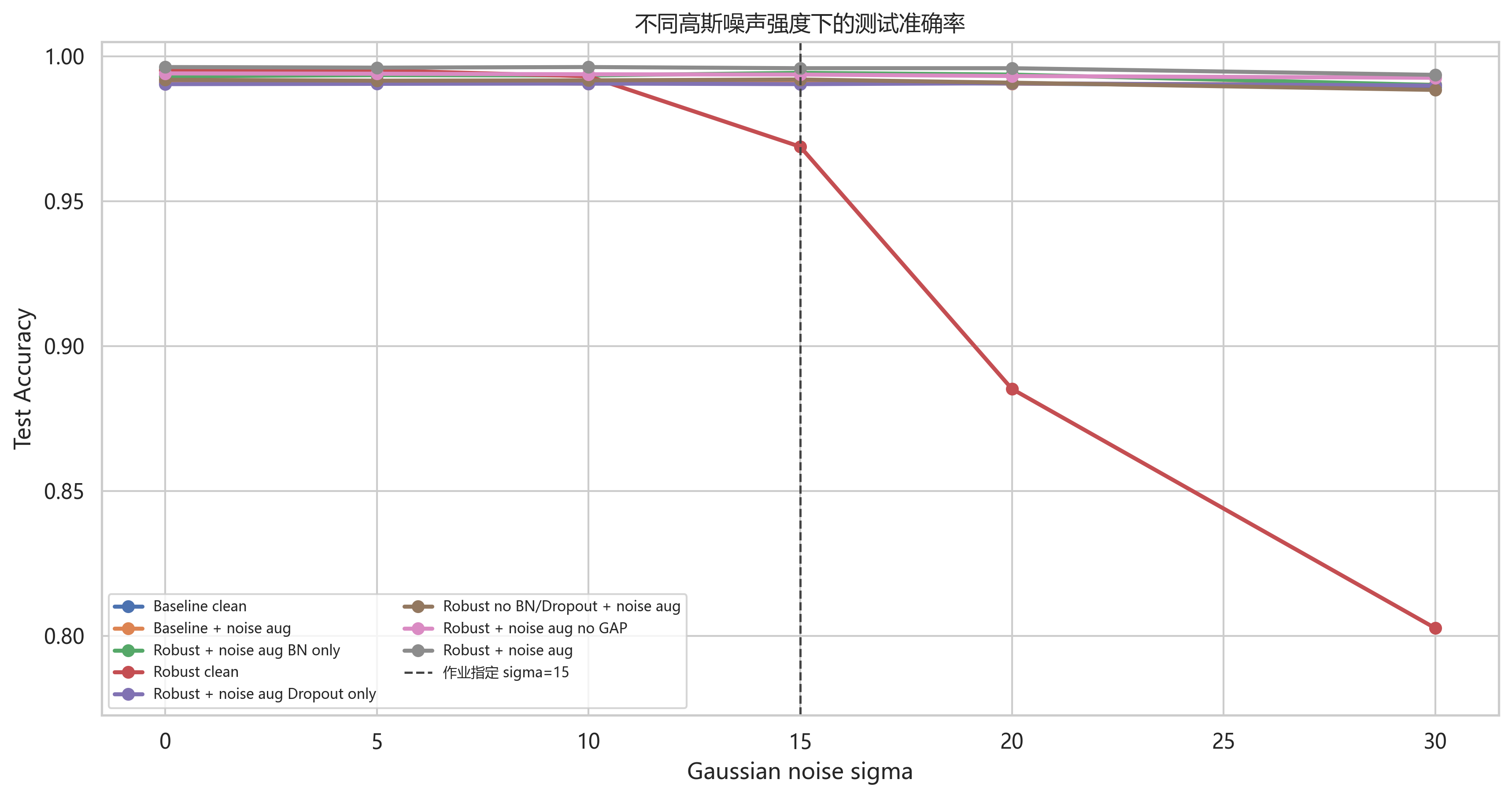
Deep Learning Exp2: MNIST Noise Robustness
A reproducible PyTorch study of LeNet-style MNIST recognition, feature visualization, self-collected handwriting samples, and Gaussian-noise robustness.
Role: Built the experiment package, trained and evaluated baseline/robust CNN variants, generated figures/tables, and wrote the English report.
Methods: LeNet-style CNN, RobustNoiseCNN, feature-map and kernel visualization, noise augmentation, ablation, confusion matrices
- Compared clean/noisy MNIST accuracy, robustness curves, confusion matrices, and seed-stability checks.
- Evaluated 192 self-collected handwritten digit samples to expose a real domain gap.
- Used ablation and failure-case analysis to diagnose where noise-robust training helps.
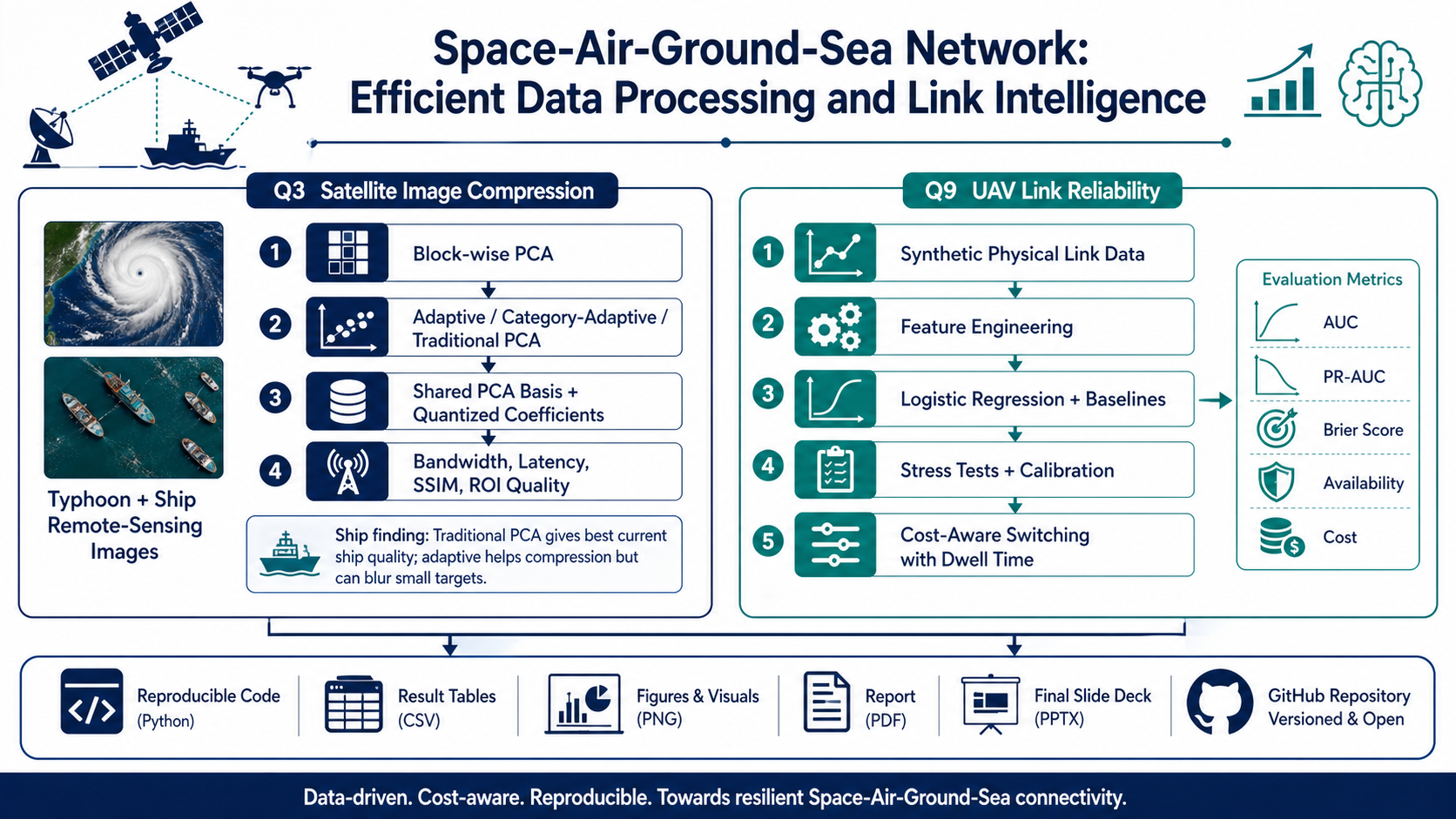
SAGIN ML: Satellite Link Optimization
A Space-Air-Ground-Sea network project combining PCA-based satellite image transmission and cost-aware UAV link switching.
Role: Built the public English release, reproduced experiments, generated result tables/figures, and documented limitations.
Methods: Traditional/adaptive/category-adaptive PCA, shared-basis compression, ROI-aware ship analysis, logistic regression, stress tests, cost-aware switching
- Connects machine learning with communication efficiency in satellite-UAV-ground-maritime scenarios.
- Shows rigorous model comparison with compression quality, calibration, stress tests, and switching cost.
- Documents a negative finding: adaptive PCA can blur small ship targets despite improving compression.
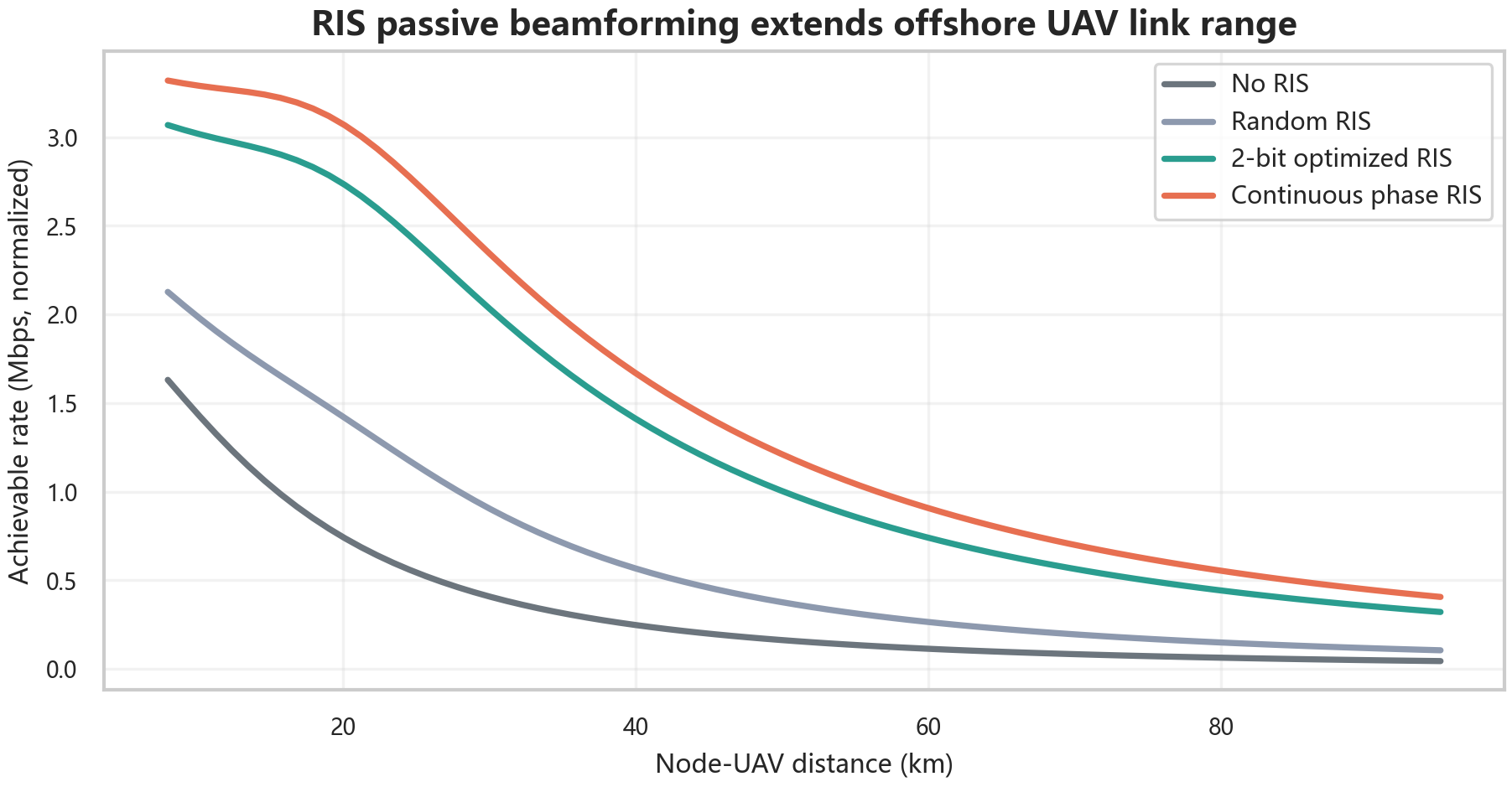
Q-RIS-UAV Secure Energy Optimization
A public academic report and reproducible simulation for QKD-protected RIS-UAV offshore monitoring with secure energy-efficiency optimization.
Role: Built the sanitized public release, scenario simulation, optimization pipeline, generated slide deck, and verification checks.
Methods: Dinkelbach transformation, alternating optimization, CVXPY resource allocation, RIS phase quantization, SCA trajectory update, QKD key constraints
- Formulated weighted secure data energy efficiency under UAV, RIS, QKD, power, bandwidth, and coverage constraints.
- Integrated typhoon context, offshore wind infrastructure, coastline data, and magnetic anomaly priority modeling.
- Produced reproducible simulations, RIS evidence, robustness/ablation/Pareto analysis, and a verified 77-slide public deck.
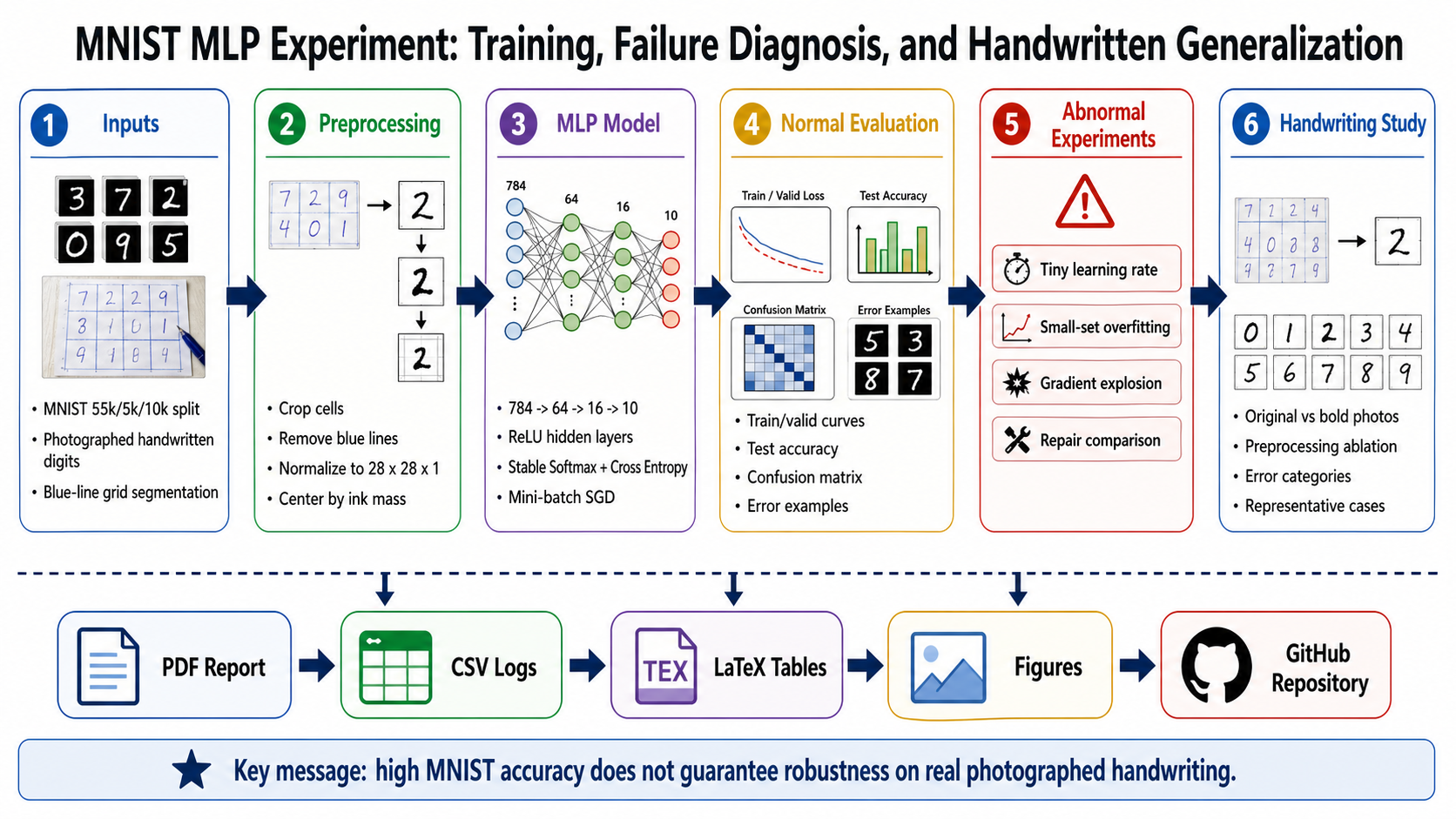
MNIST MLP Experiment Diagnosis
A complete NumPy MLP project for MNIST training, abnormal-case diagnosis, repair experiments, and photographed handwriting generalization.
Role: Implemented experiment pipelines, generated diagnostics, processed handwritten sheets, and built the final report assets.
Methods: MLP training, confusion matrix analysis, learning-rate failure, overfitting diagnosis, gradient explosion repair, preprocessing ablations
- Demonstrates quantitative debugging of training failures instead of only reporting final accuracy.
- Shows that high MNIST accuracy does not guarantee robustness on photographed handwriting.
- Connects preprocessing, representation limits, and model architecture to real error modes.
Structured training across elite engineering, research practice, neuroscience, and machine learning.
Elite undergraduate college
School of Future Technology, Intelligent Machine Platform
The School of Future Technology is Tianjin University's elite undergraduate college. The Intelligent Machine Platform honors track admits students through Gaokao-based selection and internal university selection.
The first two years provide shared training in mathematics, physics, and engineering fundamentals. After sophomore-year major selection, I chose Automation.
Rank
- Overall rank
- 8/100
- Junior specialization rank
- 1/8
Weighted score
- Overall weighted score
- 91.54
- Junior specialization weighted score
- 96.55
GPA
- Overall GPA
- 3.85/4.0
- Junior specialization GPA
- 3.98/4.0
Summer Research Visit
Shanshan Qin Lab, Shanghai Jiao Tong University. Upcoming visit as an undergraduate research assistant for summer research.
Computational Neuroscience Online Summer School
Neuromatch Academy. Upcoming training in computational neuroscience, neural data analysis, dynamical systems, learning, decision making, and cognition.
In-person Summer Research
NeoScholar and Imperial College London, supervised by Prof. Sen Wang. Developed and evaluated deep reinforcement learning methods for nonholonomic narrow dead-end escape, leading to the CSAI 2025 publication. Evaluation: A.
Robot Perception, Localization and Navigation
NeoScholar and Imperial College London audit covering SLAM, localization, navigation, and implementation-oriented robotics methods.
Robotic Manipulation
NeoScholar and Imperial College London course with high score and CIEI certification; completed kinematics, dynamics, grasping, custom gripper design, and simulation assignments.
Computing Applications in Science and Engineering
University of Bristol Summer School. Used Java and Go for scientific computing; built satellite-control simulation and Arduino/networked sensing projects.
Course clusters supporting the current neuroscience and Neuro-AI direction.
Neuroscience and Machine Learning
Brain and Cognition; Intelligent Medical Signal Processing; Optimization-based Machine Learning; Deep Learning; Pattern Recognition and Brain-like Intelligence.
Mathematics, Physics, and Computation
Mathematical Analysis; Advanced Linear Algebra; Probability and Mathematical Statistics; Fundamental Physics; Equations of Mathematical Physics; Numerical Computational Method; Discrete Mathematics.
Circuits, Signals, Control, and Robotics
Circuit Principles; Analog Circuits; Digital Circuits; Signals and Systems; Automatic Control; Theory of Motor; Robot Kinematics and Dynamics; Computer Organization and Architecture; C++ Programming.
Online Certificates and Study
MITx Introduction to Differential Equations; DelftX MECH1x Building Robots: Electrical Drives; DelftX MECH2x Building Robots: Sensors and Data Acquisition; University of Padova Foundations of Signals and Systems; Stanford Machine Learning, Deep Learning, and Convex Optimization tracks; UW Computational Neuroscience materials.